
The Sequencing Problem
Based on a survey of 60 directors and senior executives across Trinidad and Tobago, Saint Lucia, Barbados, Bahamas and Saint Vincent and the Grenadines
Executive Summary
Caribbean directors and senior executives are convinced AI will reshape their industries. They are far less prepared to govern it. Across this regional survey of boards and senior management, belief in AI’s strategic importance is close to unanimous. However, the governance mechanisms boards need to oversee AI effectively — including formal accountability, integration into enterprise risk management, board-level reporting, and dedicated resourcing — remain largely undeveloped.
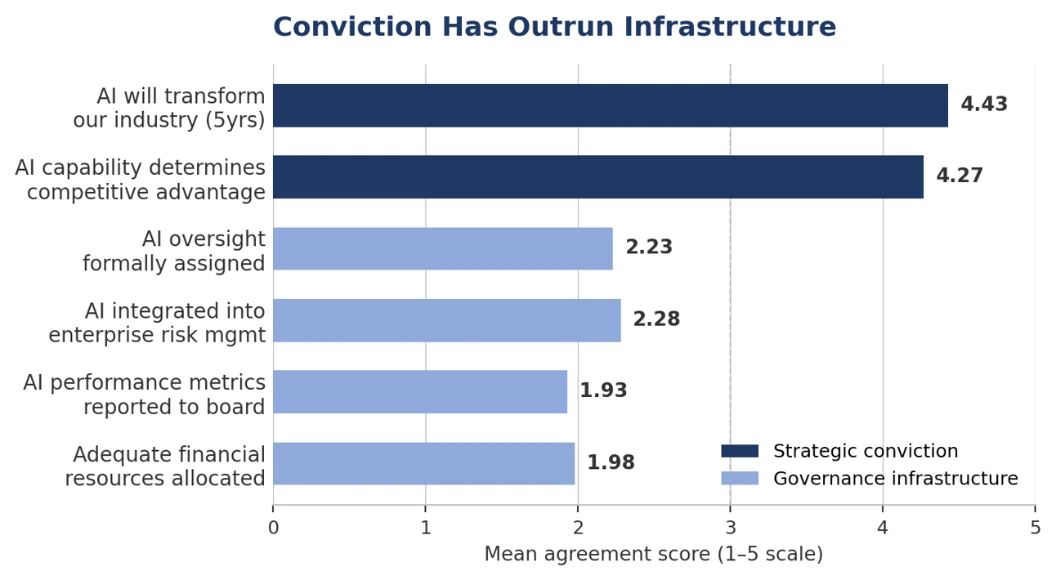
Respondents rated the statement that AI will significantly transform their industry within the next five years at 4.43 out of 5. By comparison, the statement that AI performance metrics are reported to the board received a rating of only 1.93 out of 5.
This is not primarily a knowledge problem. It is a governance-architecture problem, with potential fiduciary consequences for boards that continue to treat AI oversight as a future agenda item rather than a present responsibility.
This brief presents four key findings from the data and outlines practical actions boards can take immediately.
Why This Matters Now
AI adoption is already underway across Caribbean organisations. Its use is uneven and, in many cases, informal, but it is advancing regardless of whether governance structures have kept pace.
Thirty-six of sixty respondents indicated that their organisations have progressed beyond the “no deployment” stage. Most described their current level of adoption as “limited” or “pilot,” rather than fully absent.
Boards therefore do not have the option of waiting for a settled governance framework before treating AI as a live oversight issue. In most of the organisations represented in this study, it already is one.
The resulting exposure is not speculative. Respondents identified cybersecurity risk, regulatory uncertainty, and ethical/reputational risk among the most significant barriers to AI adoption – ranking them ahead of board AI literacy.
Directors are not underestimating the potential consequences. What remains absent is the institutional machinery needed to translate that awareness into effective oversight.
What We Found
1. A wide gap exists between strategic conviction and governance infrastructure
Every governance mechanism assessed in the survey — including reference to AI in strategic plans, formal assignment of oversight responsibility, integration into enterprise risk management, board-level reporting, and dedicated financial resourcing — received a score below the midpoint of the scale.
At the same time, respondents’ belief that AI will transform industries and influence future competitive advantage consistently scored above 4 out of 5.
Key governance scores include:
- Oversight responsibilities formally assigned: 2.23/5.
- Adequate financial resources allocated to AI initiatives: 1.98/5.
- AI integrated into enterprise risk management: 2.28/5.
Strategic conviction has outpaced governance capacity.
This is precisely the type of imbalance boards are expected to identify and correct. Yet across most of the organisations surveyed, the necessary correction has not yet taken place.
2. Governance is following deployment rather than preceding it
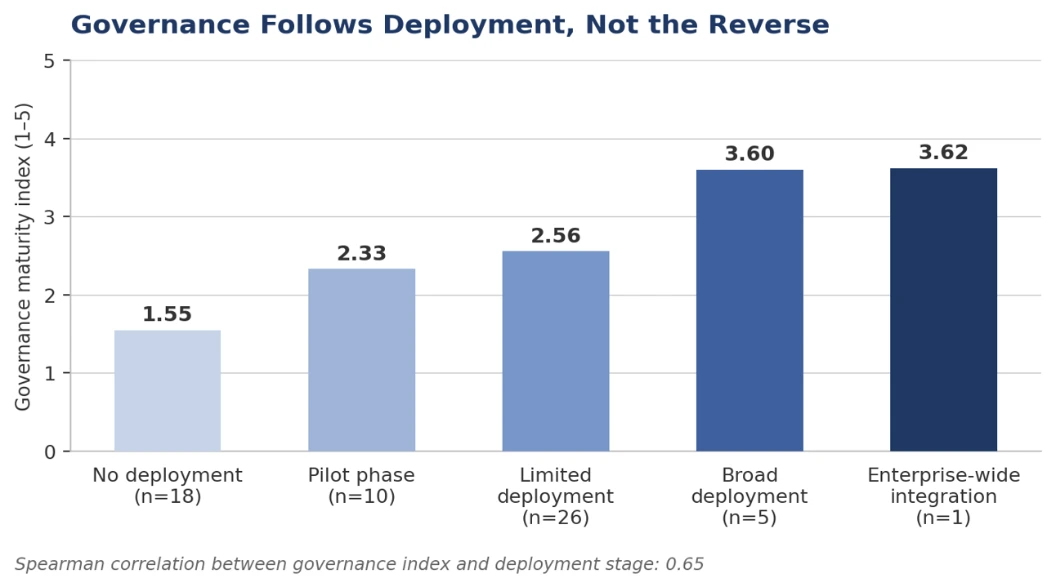
Governance maturity is closely associated with how far an organisation has already progressed in deploying AI (the correlation between the survey’s composite governance index and deployment stage is 0.65).
Organisations reporting no AI deployment recorded the lowest governance-readiness score, at 1.55 out of 5. Organisations with board or enterprise-wide AI deployment recorded the highest scores, at approximately 3.6 out of 5.
In practice, this suggests that governance structures are often being introduced after organisations have already taken on AI-related exposure, rather than being designed before deployment begins.
For boards, this is the wrong sequence.
Oversight structures should be established as a condition for approving new risk exposure – not introduced retrospectively after that exposure has already occurred.
3. A regional governance risk is recognised, but the local risk is not
Respondents who believe Caribbean boards are generally underprepared for AI oversight are also more likely to view AI as a material systemic risk to Caribbean markets.
However, that belief has almost no relationship with the governance maturity of the respondent’s own organisation.
The correlation between the belief that “boards in the Caribbean are underprepared” and perceived regional systemic risk is 0.48. The correlation between the same belief and the governance maturity of the respondent’s own organisation is −0.02.
Directors therefore appear able to identify a regional governance deficit while remaining largely unaware of, or insufficiently concerned by, the possibility that the same deficit exists within their own organisations.
This is a familiar pattern in governance and risk research — a general external risk is often easier to recognise than the same risk within one’s own organisation.
Boards should name this bias explicitly. It is the kind of bias that self-assessment alone will not correct.
4. Boards and the C-suite are not seeing the same picture
On almost every governance measure, C-suite executives rated their organisation’s AI governance maturity more positively than board members did.
This includes whether the board understands AI’s implications for the organisation’s industry:
- C-suite: 3.11/5
- Board members: 2.62/5
It also includes whether the organisation has access to AI expertise:
- C-suite: 3.28/5
- Board members: 2.69/5
At the same time, C-suite respondents rated Caribbean boards in general as more underprepared for AI oversight, at 4.67 out of 5, than board members rated themselves, at 3.81 out of 5.
Taken together, these findings point to a communication and perception gap between the executive and oversight layers of the organisation.
Management may be assuming a level of board engagement that board members themselves do not report. Alternatively, boards may be underreporting engagement that is already place.
Either way, the disconnect itself is a governance risk. A board cannot effectively oversee an issue that it and management do not understand, assess, and describe in consistent terms.
Barriers, as ranked by Directors
Directors do not primarily attribute slow progress in AI governance to limited board literacy.
Cybersecurity risk and budget constraints were rated as greater obstacles than limited board -level AI literacy, which was the lowest-ranked barrier among the eight assessed.
This finding challenges the assumption that director training alone will close the AI governance gap.
Training remains important, but respondents indicate that the more binding constraints are financial resourcing, cybersecurity exposure, regulatory uncertainty, and the absence of an integrated enterprise risk architecture.
What This Means for Directors
- Treat AI oversight as a pre-condition for AI adoption, not a follow-up activity. Any proposal to deploy or expand the use of AI should include formal governance and risk approval before implementation, rather than relying on retrospective review.
- Cross-check management’s account of board engagement against the board’s own assessment. The gap identified in this survey is precisely the type of disconnect that a candid and structured board evaluation should face.
- Challenge the assumption that the Caribbean’s AI governance deficit is a market-wide problem that does not apply to your own organisation. The data suggests this assumption may be widespread and largely unexamined.
- Reframe the discussion about barriers. AI governance is substantially a resourcing and risk-architecture challenge, not simply a director-training challenge.
A Short Governance Checklist
1. Assign formal oversight.
Name an individual, board committee, or management committee with clear accountability for AI oversight. This responsibility should be documented before further deployment proceeds.
2. Integrate AI into enterprise risk management.
AI-related risk should be incorporated into the organisation’s existing enterprise risk management framework and reporting cycle. They should not be managed through an informal or parallel process.
3. Require board-level reporting.
Establish a standing schedule for AI performance, risk, compliance and incident metrics to be reported to the board. Board-level reporting was the weakest-scoring governance item in the survey.
4. Reconcile the board/management perspectives.
Conduct a structured discussion — not simply a status update — to compare management’s assumptions about the board’s understanding with board members’ actual level of understanding.
5. Match resourcing to ambition.
Respondents’ forward-looking AI investment intentions scored 3.52 out of 5, compared with 2.37 out of 5 for precious investment levels. As investment ambition increases, governance and risk-management resources must increase along it rather than continuing to lag behind.
6. Ask the uncomfortable local question.
Do not stop at agreeing that “Caribbean boards” are underprepared. Ask, directly, specifically and on the record: Is this board prepared?
Concluding Thoughts
The organisations represented in this survey are not lacking conviction about AI. What they lack is the governance architecture needed to match that conviction.
The data suggests that this gap is broad-based across sectors, organisational sizes, and territories. It is not confined to smaller, less sophisticated, or less-resourced organisations.
That breadth is itself the finding.
This is not a case of a small number of boards falling behind; it is a regional pattern in how boards are responding to a technology whose consequences they already, by their own account, expect to be substantial.
The organisations that close this gap first will not simply be better governed. They will also be better positioned to adopt and scale AI confidence -because their boards will have tested their oversight arrangements rather than merely assumed those arrangements are adequate.
Methodology note: The findings are drawn from a survey of 60 directors and senior executives (board members, CEOs/MDs, C-suite executives, and senior managers). Respondents represented organisations primarily located in Trinidad and Tobago, Saint Lucia, Barbados, the Bahamas, and Saint Vincent and the Grenadines, spanning financial services, education, government, energy, retail, and other sectors. Governance maturity is expressed as a composite index based on eight survey items covering strategic reference, board understanding, oversight assignment, risk integration, reporting, training, and resourcing. Correlations reported are Spearman rank correlations.
About the Author
Ron Sookram serves as Chief Academic Officer at the Arthur Lok Jack Global School of Business, The University of the West Indies (UWI-ALJGSB), Trinidad and Tobago. He is also the School’s resident consultant in corporate governance, leading strategic governance interventions and providing expert guidance to boards across a diverse range of organisations.
Ron can be reached at r.sookram@lokjackgsb.edu.tt